GDPR compliant: what your company has to be able to demonstrate
The GDPR asks two things: your company complies with the principles in Art. 5(1), and it can demonstrate that (Art. 5(2), accountability). To do so it takes measures that fit its processing and the risks involved, and keeps them up to date (Art. 24(1)). The proof rests on records such as the record of processing, the TOMs and the contracts.


What does GDPR compliant mean?
The word does not appear in the GDPR. What it means is what Art. 5 requires: personal data is processed according to six principles, and the controller is responsible for complying with them and must be able to demonstrate it.
The principles in Art. 5(1) are lawfulness, fairness and transparency; purpose limitation; data minimisation; accuracy; storage limitation; integrity and confidentiality.
Paragraph 2 calls the duty to demonstrate accountability. Complying and proving it therefore go together: when your company is asked, it shows how it puts the principles into practice.
Art. 5(1) and (2) GDPR
What Art. 24 asks of your company
Art. 24(1) turns this into a duty to act. The controller implements appropriate technical and organisational measures to ensure that processing complies with the GDPR and to be able to demonstrate it. What is appropriate depends on the nature, scope, context and purposes of the processing and on the risks to people's rights and freedoms.
The measures are reviewed and updated where necessary. Where proportionate to the processing, they include appropriate data protection policies (paragraph 2); the German text says “Datenschutzvorkehrungen”, in our reading written rules either way.
For a company with 50 to 250 staff this means, in our reading: records for what you actually process, as detailed as the risk requires. Payroll needs different safeguards from tracking employees' locations.
Art. 24(1) and (2) GDPR
Which records carry the proof
The record of processing activities shows what you process and why, and you make it available to the supervisory authority on request (Art. 30(1) and (4)). The TOMs describe how you protect the data (Art. 32). Data processing agreements show that your service providers are bound (Art. 28).
Where a data protection impact assessment is required, it belongs here too (Art. 35). You document personal data breaches with the facts, effects and remedial action, by the wording including those you do not have to notify (Art. 33(5)). Where processing is based on consent, you must be able to demonstrate the consent (Art. 7(1)).
We cover the record of processing, TOMs, DPAs, the DPIA and data breaches in an article each.
Art. 7(1) · Art. 28 · Art. 30 · Art. 32 · Art. 33(5) · Art. 35 GDPR
An example: the authority asks
Lenz Kunststofftechnik GmbH (made up, 160 staff) gets a letter from the data protection authority of its federal state. A former applicant has complained that his documents are still stored. The authority wants to know how Lenz handles applicant data.
Lenz produces the entry “Applications” from its record of processing with purpose and erasure period, the DPA with the vendor of its applicant portal, and the TOMs for the portal. The company adds the log of the last deletion run.
Had the erasure period only been in its privacy notice, Lenz could have named it but not proven that it is kept. That is exactly the difference Art. 5(2) makes, here for the principle of storage limitation (paragraph 1(e)).
Common mistakes
Relying on a seal or on a vendor's claim. A certification under Art. 42 relates to processing operations and does not reduce your responsibility (paragraphs 1 and 4). The GDPR's obligations fall on controllers and processors. Whether a piece of software fits depends on how you use it.
Writing the records once and leaving them. Art. 24(1) requires the measures to be reviewed and updated where necessary; an old record proves an old state.
Taking the exemption for organisations with fewer than 250 employees as a general one. It concerns the record of processing and falls away once a processing is not occasional, such as the monthly payroll (Art. 30(5)).
Art. 24(1) · Art. 30(5) · Art. 42(1) and (4) GDPR
With an AI assistant
An AI assistant such as Claude, ChatGPT or Copilot can build an overview from the records you already have: which proof exists, which is missing and which is out of date, sorted by the principles in Art. 5(1). It can draft missing entries and prepare a reply to the authority.
Whether a measure is appropriate and what you send the authority is your company's decision. In our reading, a draft becomes proof only once you have checked it and adopted it. Whatever you show the assistant, its vendor processes too; settle first under which agreement that happens.
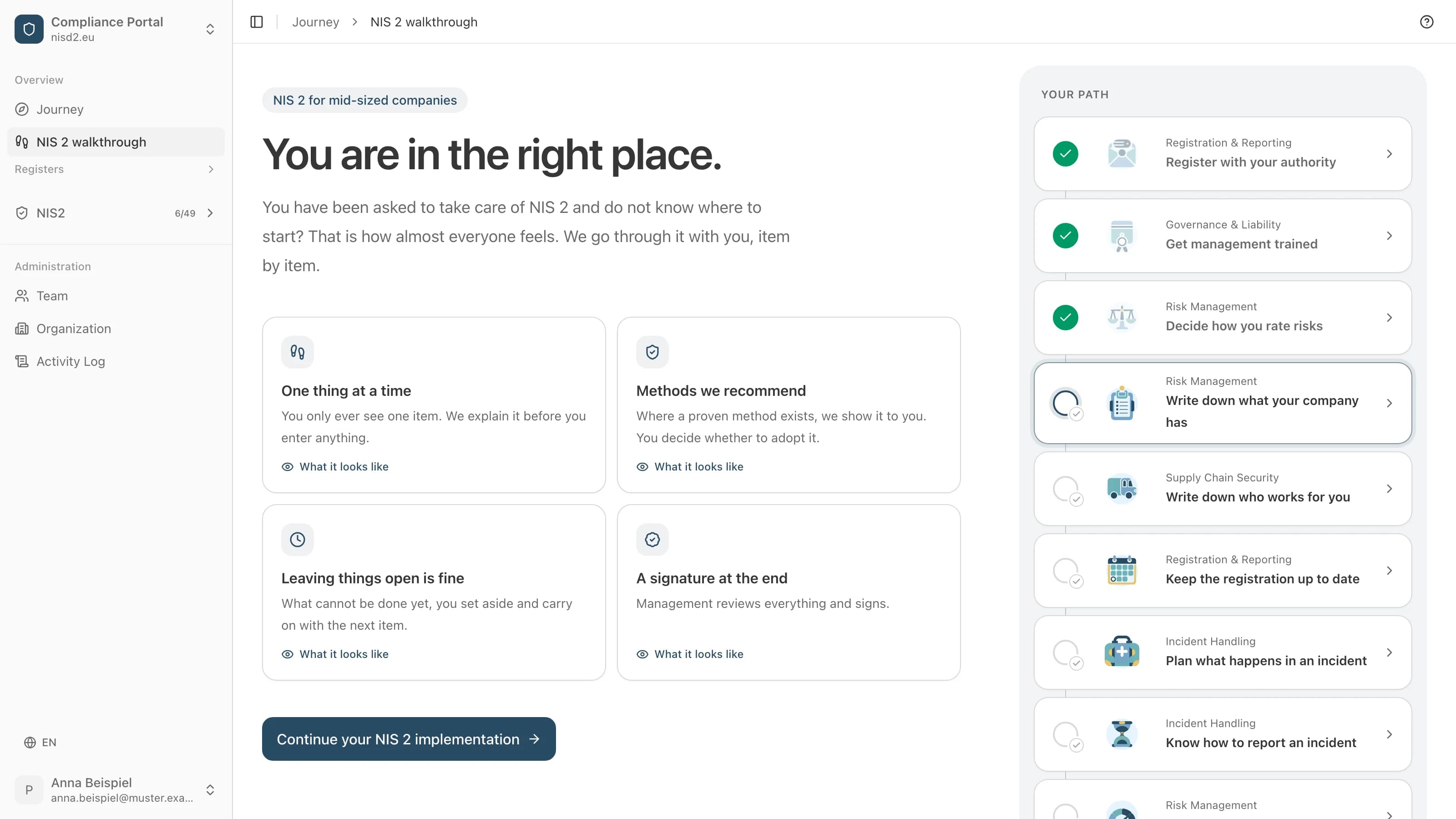
The NIS 2 walkthrough on nisd2.eu does not cover the GDPR. A GDPR walkthrough on nisd2.eu is in the works, with the same MCP server as the NIS 2 walkthrough.
Common questions
Is there an official GDPR certificate?
The GDPR provides for voluntary certification mechanisms and data protection seals and marks (Art. 42(1) and (3)). They relate to processing operations. A certification can help demonstrate that you meet your obligations (Art. 24(3)), but it does not reduce your responsibility (Art. 42(4)).
From how many employees does the GDPR apply?
The GDPR has no minimum size: it applies to the processing of personal data wholly or partly by automated means and to structured paper files (Art. 2(1)). Some obligations have thresholds, such as the record of processing (Art. 30(5)). In Germany your company needs a data protection officer if it constantly employs as a rule at least 20 persons dealing with the automated processing of personal data (§ 38(1) BDSG).
Is a data protection officer enough to be GDPR compliant?
No. The data protection officer informs, advises and monitors (Art. 39(1)). Your company remains responsible for compliance and for demonstrating it (Art. 5(2), Art. 24(1)).
What belongs in a GDPR checklist?
A checklist helps if it asks about your own processing. For each one, go through the six principles in Art. 5(1) and note which record shows that you comply. Where no record is listed, there is a gap in your proof.
Who checks whether a company is GDPR compliant?
The data protection authority; for companies in Germany, the authority of the federal state (§ 40(1) BDSG). It can order you to provide any information it needs for its tasks (Art. 58(1)(a)), and your company cooperates with it on request (Art. 31).
Read next
Sources
- Regulation (EU) 2016/679 (GDPR), Art. 2, 5, 7, 24, 28, 30, 31, 32, 33, 35, 39, 42 and 58, CELEX 32016R0679, publications.europa.eu
- Corrigendum to the GDPR in OJ L 314 of 22.11.2016, German text of Art. 30(5), CELEX 32016R0679R(01), publications.europa.eu
- German Federal Data Protection Act (BDSG), § 38 and § 40, with the official English translation, gesetze-im-internet.de
In the works
The GDPR walkthrough
After the NIS 2 walkthrough, nisd2.eu is building a GDPR walkthrough. It will work with the same MCP server, so your own AI assistant can fill it in too. We are not naming a date yet. Join the waitlist and we will write to you once it is ready.
With a free account on nisd2.eu. You can leave the waitlist at any time on the same page.
Máte se postarat o NIS2?
Provedeme vás krok za krokem. Vy vyplňujete, my vysvětlujeme každý bod srozumitelně a na konci podepisuje vedení.